Wednesday, January 18, 2023

US hay stocks fall to lowest level since ’74


Drought and high fertilizer prices took a significant bite out of hay production across the U.S. Extension Economist James Mitchell expects farmers will pay more for hay in the current marketing year. (U of A System Division of Agriculture file photo by Lauren Husband)

Nationwide, other hay production totaled 64.84 million tons in 2022, down 9 percent from the prior year.

By Mary Hightower
U of A System Division of Agriculture

Fast facts

  • U.S. hay production down 9 percent
  • U.S.’s largest producer, Texas, saw 40 percent decline

FAYETTEVILLE, Ark. — High fertilizer prices and drought in 2022 handed hay production in the United States its biggest decline in 11 years with stocks at their lowest level since data collection began, according to the National Agricultural Statistics Service.

The stats were part of the Jan. 12 Crop Production Summary from NASS, which is part of the U.S. Department of Agriculture. The report includes information about all U.S. crops, their production, acreage, and yield. NASS places hay in two categories, alfalfa and “other hay,” the latter being relevant to the Southeastern U.S. 

According to the summary, May 1 hay stocks were tight, totaling 16.77 million tons or 7 percent lower year over year.

“May 1 stocks, combined with lower 2022 hay production, put hay supplies at the lowest level on record since the data began in 1974,” said James Mitchell, extension economist for the University of Arkansas System Division of Agriculture. “The previous record low in hay supplies was in 2021.”

Production declines
Nationwide, other hay production totaled 64.84 million tons in 2022, down 9 percent from the prior year, with Arkansas seeing a 16 percent decline. Texas, the nation’s largest hay-producing state, produced 6.15 million tons, a 40 percent decline compared to 2021.

“Most Southern Plains and Southeast states had double-digit hay production declines,” said Mitchell said.

Mississippi saw a 16 percent decline, Tennessee a 13 percent decline, and Kentucky, a 20 percent decline. Florida bucked the trend, seeing a 7 percent increase in hay production. 

“USDA’s estimate for Arkansas is much better than what I would have predicted last summer,” Mitchell said. Based on conversations with producers last year, he said “I was expecting a decline closer to 25 percent.

“It was hard to predict whether we would get late-season rain last summer,” Mitchell said. “It was even hard to predict whether a late-season rain would help us make up for the severe production losses we had in July. Conditions improved enough in September for us to make up for some of that loss.”

Yields down
“Expensive fertilizer and poor precipitation impacted yields,” he said. “U.S. hay yields averaged 1.87 tons per acre or 6 percent lower year over year. Yields dropped 9 percent in Arkansas to two tons per acre. Neighboring Oklahoma and Texas saw yields averaging 1.25 tons per acre and 1.50 tons per acre, respectively.”

Overall, other hay acreage fell 2 percent to 34.63 acres. Arkansas’ hay acres declined by 5 percent, while Texas saw a 25 percent reduction in hay acres in 2022.

Mitchell said that “declining cattle inventories, expensive inputs, and high crop prices all likely contributed to the decline in 2022 hay acreage.”

Higher prices
Mitchell said farmer would likely be paying more for hay.

“Like other commodities, price comparisons are based on the marketing year,” he said. The hay marketing year begins in May and ends in April.

“For the May 2021-April 2022 marketing year, prices averaged $147 per ton,” Mitchell said. “For the May 2022-April 2023 marketing year, we forecast prices to average $170 per ton.”


National forage and grazing experts to speak at annual conference


WEST LAFAYETTE, Ind. — The Heart of America Grazing Conference will take place Feb. 20 and 21 at the Ferdinand Community Center in Ferdinand, Indiana. Hosted by the Indiana Forage Council (IFC) in collaboration with Purdue Extension, the annual event will feature forage and grazing experts from across the nation.

 “Attending the Heart of America Grazing Conference is an invaluable opportunity to network with forage-livestock input providers at the trade show, and networking with participants that have an interest in pasture improvement has value, too,” said Keith Johnson, a professor of agronomy in Purdue University’s College of Agriculture.

Highlighted speakers will lead discussions on cutting-edge research in grazing, soil science and grazing options with cattle and small ruminants, among other key topics.

Jason Tower, superintendent of the Southern Indiana Purdue Agricultural Center, and Ronald Boehm of Boehm Farms are featured speakers.

 “The 2023 conference will be an excellent opportunity for producers and educators to expand their knowledge of grazing and soil management. Improving these skill sets can have a positive impact not only on livestock performance but also on the environment,” Tower said.

Boehm said, “The timing of the conference works well for the attendees to take their newly gained knowledge back home and begin to plan for implementation as they strive to refine their operations toward their goals of livestock husbandry, financial success and environmental stewardship.”

Additional speakers include Greg Halich, University of Kentucky; Alan Franzluebbers, USDA-ARS North Carolina; and Johnny Rogers, coordinator of the Amazing Grazing Project and North Carolina State University.

Registration information and event details can be found on the IFC website and Facebook page.


Friday, January 13, 2023

Texas A&M launches largest ag scholarship campaign

 Dean’s Excellence Scholarships campaign begins in 2023

The most aggressive scholarship campaign in the history of the Texas A&M College of Agriculture and Life Sciences began today with an announcement by Jeffrey W. Savell, Ph.D., vice chancellor and dean of agriculture and life sciences, of the Dean’s Excellence Scholarships.

A group of College of Agriculture and Life Sciences students stand outside in a garden atmosphere listening to a class.
Students will be attracted to the Texas A&M College of Agriculture and Life Sciences with the newly announced Dean’s Excellence Scholarship campaign. (Texas A&M AgriLife photo by Sam Craft)

The campaign will create a series of $100,000 endowments as part of a large initiative for the College to recruit and support undergraduate students. These endowments will create numerous four-year scholarships of $4,000 or more per year.

To kick off the campaign and immediately begin supporting students in the fall of 2023, Savell has pledged the College to fund 60 scholarships for 2023 and 2024 entering freshman, 30 scholarships for each year.

Focused on finding high-achieving students in Texas and beyond, the Dean’s Excellence Scholarships will support students who excel holistically and are pursuing bachelor’s degrees within the College.

The campaign’s first goal is to create at least 30 scholarship endowments by the end of 2023, Savell said.  

“It’s an utmost priority for me to recruit the best and brightest students to the College of Agriculture and Life Sciences,” Savell said. “We want to make sure our students are set up for success as they graduate and begin their careers or go on to professional or graduate school.”

Beginning a new legacy of student support

This announcement marks the first set of Dean’s scholarships for the College, and Savell said the endowments create a legacy for all future deans to continue the support of student excellence.

“Four-year scholarships allow us to reciprocate the commitment that students are making to us when they enroll to Texas A&M College of Agriculture and Life Sciences,” Savell noted. “This lets students and the College begin an educational journey together based on mutual responsibility and support. A four-year scholarship can be life-changing for some.”

A man in military dress shakes hands on a College of Agriculture and Life Sciences graduation stage with others behind him
The Corp of Cadets will be a focus of the newly announced Dean’s Excellence Scholarship campaign. (Texas A&M AgriLife photo by Michael Miller)

While the Dean’s Excellence Scholarships are meant to support all areas of study and are open to all incoming students, the first year will have an additional focus on future Corps of Cadets members and first-generation students. Both these groups are emphasized in Texas A&M University’s recruitment mission.

“We’re looking for the best students,” Savell explained. “We’ve included Corps of Cadets as a focus area because of our long and close relationship with the Corps, and in support of President Banks’ March to 3,000 initiative to increase the Corps membership to 3,000 members.”

“About one-fourth of our students today are first generation,” Savell said. “We have a responsibility to help plant the seed for generations to come. These investments will change family trees and improve society by advancing all areas of agriculture and life sciences. As a first-generation student myself, I feel this deeply.”  

A growing population of potential students

As the Texas population nears 30 million residents, Savell explained that he is working to increase the number of students enrolled at the College. In his “State of AgriLife” address given to Texas A&M AgriLife employees today, he highlighted the comprehensive nature of the College, mentioning that the fields of study within agriculture and life sciences impact every part of Texans’ lives. The College’s 15 departments range from traditional production agriculture to biophysics, biological engineering, forensics, nutrition, ecology, conservation, hospitality, tourism and beyond.

For more information on the endowed Dean’s Excellence Scholarship program please contact Jennifer Ann Scasta, senior director of development, at jscasta@txamfoundation.com or 979-845-7594.

Thursday, January 12, 2023

USDA Reminds Producers of Continuous Certification Option for Perennial Forage


WASHINGTON, Jan. 11, 2023 – The U.S. Department of Agriculture (USDA) reminds agricultural producers with perennial forage crops of an option to report their acreage once, without having to report that acreage in subsequent years, as long as there are no applicable changes on the farm. Interested producers can select the continuous certification option after USDA’s Farm Service Agency (FSA) certifies their acreage report.  

“FSA’s continuous certification option simplifies future acreage reporting of perennial crops, and it can also help streamline the application process for many of our farm programs, including disaster assistance programs,” said FSA Administrator Zach Ducheneaux. “For example, when persistent drought conditions over the past year affected livestock producers in the West and Great Plains, producers who had previously filed a continuous acreage report were able to benefit from a streamlined application process for the Livestock Forage Disaster Program.”  

An acreage report documents a crop grown on a farm or ranch and its intended uses, including perennial crops like mixed forage, birdsfoot trefoil, chicory/radicchio, kochia (prostrata), lespedeza, perennial peanuts and perennial grass varieties. To access many USDA programs, producers must file an accurate and timely acreage report for all crops and land uses, including failed acreage and prevented planting acreage.  

The perennial crop continuous certification process requires a producer to initially complete an acreage report certifying the perennial crop acreage. The producer may select the continuous certification option any time after the crop is certified.  Once the continuous certification option is selected, the certified acreage will roll forward annually and does not require additional action on the producer’s part in subsequent years unless the acreage report changes.  

Once a producer selects continuous certification, then continuous certification is applicable to all fields on the farm for the specific crop, crop type and intended use. If continuous certification is selected by any producers sharing in the crop, then the continuous certification is applicable to fields in which the producer has a share for the specific crop, crop type and intended use.

“Currently less than half of the 336.5 million acres of perennial forage is being reported using the continuous certification process,” Ducheneaux said. “Producers can help streamline the reporting process by selecting continuous certification after filing their crop acreage report.” 

Producers can opt out of continuous certification at any time. The continuous certification will terminate automatically if a change in the farming operation occurs.  

How to File a Report   

To file a crop acreage report, producers need to provide:   

  • Crop and crop type or variety.   
  • Intended use of the crop.   
  • Number of acres of the crop.   
  • Map with approximate boundaries for the crop.   
  • Planting date(s).   
  • Planting pattern, when applicable.   
  • Producer shares.   
  • Irrigation practice(s).   
  • Acreage prevented from planting, when applicable.    
  • Other information as required.   

More Information  

Producers can contact their local FSA office to see if their crops are eligible for continuous certification or to make an appointment. Producers can make an appointment to report acres by contacting their local USDA Service Center.    

USDA touches the lives of all Americans each day in so many positive ways. In the Biden-Harris administration, USDA is transforming America’s food system with a greater focus on more resilient local and regional food production, fairer markets for all producers, ensuring access to safe, healthy and nutritious food in all communities, building new markets and streams of income for farmers and producers using climate smart food and forestry practices, making historic investments in infrastructure and clean energy capabilities in rural America, and committing to equity across the Department by removing systemic barriers and building a workforce more representative of America. To learn more, visit www.usda.g

Tuesday, November 15, 2022

Seed-based technology offers peace of mind from sorghum forage risk


tuinstra-texas

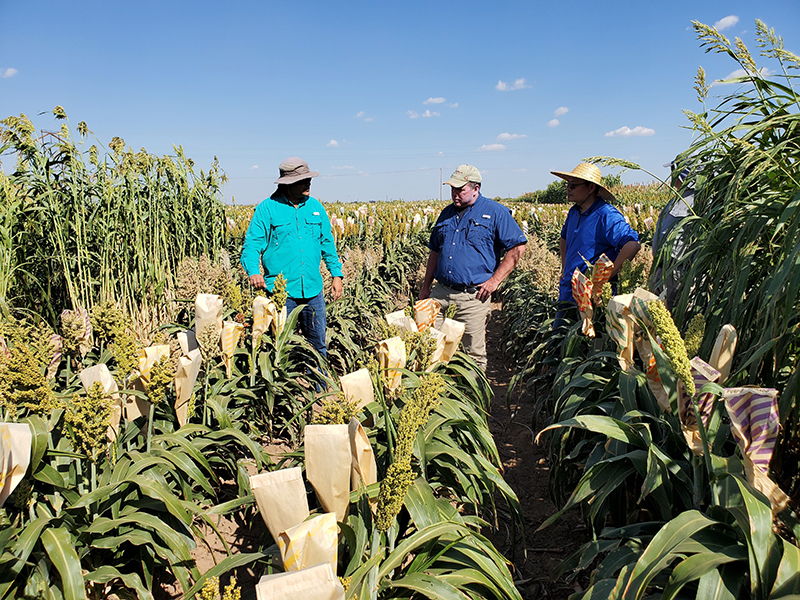
Purdue’s Mitch Tuinstra (center) discusses the progress of prussic-acid free sorghum tests in west Texas with forage breeder Mauricio Barbosa (left) and molecular lab director Wayne Shen, both of S and W Seed Co. (Photo courtesy of Scott Staggenborg/S and W) 

WEST LAFAYETTE, Ind. — Sorghum has served as a food and feed crop for thousands of years, yet it can become poisonous under drought or freezing conditions. The problem is dhurrin, which breaks down to form prussic acid, also known as hydrogen cyanide.

 But Purdue University’s Mitch Tuinstra, professor of plant breeding and genetics and scientific director of the Institute for Plant Sciences in the College of Agriculture, has developed a dhurrin-free sorghum technology that will set farmers’ minds at ease. The S&W Seed Co. of Longmont, Colorado, has licensed the technology, which will be widely available to growers in 2023.

“Cyanide poisoning is something that people who graze cattle on sorghum always have to be concerned about. It doesn’t happen all that often. But when it does happen, it’s a serious thing. This technology eliminates that risk,” said Brent Bean, director of agronomy at the United Sorghum Checkoff Program in Lubbock, Texas. USCP is a producer-funded organization dedicated to improving the sorghum industry through research, promotion and education.

At $1,300 or more per steer, cattle are a big investment.

“You lose even one, that is a big downside to the bottom line,” Bean said.

Making cyanide helps sorghum fend off chewing insects and grazing animals. But farmers still use sorghum as a forage crop because it works well in high temperatures, it tolerates drought and it produces a lot of feed with fairly minimal input.

tuinstra-sorghum

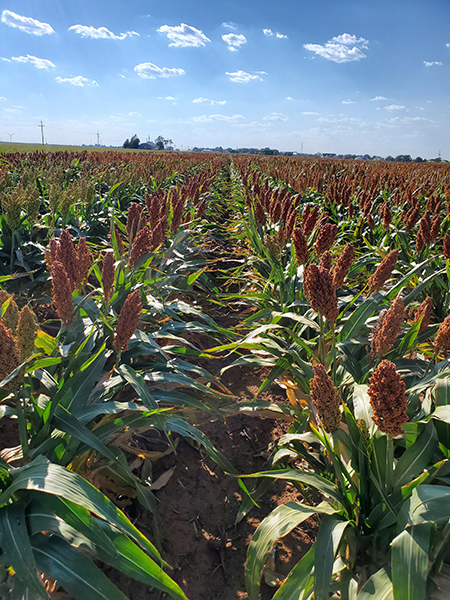
A field in west Texas where S and W Seed Co. is testing a prussic acid-free sorghum developed by Purdue’s Mitch Tuinstra. (Photo courtesy of Scott Staggenborg/S and W) 

“Sorghum is grown where it’s too hot and dry to grow other crops,” said Tuinstra, who also is Purdue’s Wickersham Chair of Excellence in Agriculture Research. “It’s grown where you don’t have other options. You can’t grow corn in these environments because it won’t survive.”

Farmers who grow sorghum in such environments have to manage it carefully to minimize the risk.

“Every farmer I talk to has stories about animals having problems, either small problems or major problems,” said Tuinstra. “This is a technology that can help alleviate that concern.”

Tuinstra began thinking about removing dhurrin from sorghum in late 2008.

“I thought that would be interesting because we know the genes, the enzymes, the biochemistry, but many questions about dhurrin metabolism remain unanswered,” he said. “So, the next summer, we started producing the genetic materials for this study.”

Sorghum is used worldwide, including in Africa, Australia, North and South America, and South Asia.

“Sorghum is an important crop in any place you have a hot, dry climate. And with climate change, that’s potentially very important,” said Jay Hulbert, president and CEO of Ag Alumni Seed in Romney, Indiana. “There are areas in the U.S. and globally where people grow other crops, especially corn, where they’d probably be better off growing sorghum.”

Scott Staggenborg, S&W’s sorghum product marketing manager for the Americas, expressed excitement for the technology because it solves a problem in a widely used product. Growers are also enthused.

“I have people saying, ‘I’ll buy every bag you have,” Staggenborg said. He noted that the technology can work in any type of sorghum, including sorghum-sudangrass, a summer annual with a robust yield that is hard to match.

“Lots of cattle are grown in semiarid and arid environments. Sorghum-sudangrass is important globally because of its drought tolerance and heat tolerance,” Staggenborg said.

Tuinstra partnered with Hulbert to develop prototype varieties, a patent and a business plan for the technology. They had considered launching a seed company in Indiana, but they learned that sorghum seed production works better in dry climates.

“Indiana is great for a lot of things, but not necessarily for making sorghum seed on a large scale,” Hulbert said. This led them to the S&W Seed Co., which is running trials this year in west Texas on Tuinstra’s most promising hybrids.

“This is a classic example of how university research is supposed to work,” Hulbert said. “Mitch had an idea and started working on something successful that none of the sorghum seed companies were working on. Then we find a way to take it to farmers through commercial channels to the private sector.”

Another key aspect of the technology was working with the Indiana Crop Improvement Association, an agency that certifies seed quality. The ICIA patented a new seed-quality assay using dhurrin-free sorghum as the prototype. The assay makes it possible to test large lots of seed with a high-tech, DNA sequencing-based approach to quality assurance.    

“At Purdue University, we’re interested in developing transformative technologies that solve farmer challenges, and we’re trying to do that very broadly within Indiana, the U.S. and internationally,” Tuinstra said.

Friday, November 11, 2022

Veteran Women for the Land Project Releases Report

Findings Highlight Tangible Recommendations for the 
Pacific Northwest and Beyond 

Washington, D.C. – The Veteran Women for the Land project -- a partnership between American Farmland Trust, Farmer Veteran Coalition, Farmer Veteran Coalition-Washington Chapter, Annie’s Project, Rogue Farm Corps, Washington State Department Veterans Affairs, Washington Farmland Trust, Oregon State University Extension Services Small Farms Program, and Insight for Action -- released Veteran Women in Agriculture: A regional needs assessment for the Pacific Northwest”, which provides a synthesis of research to determine how to better serve this community, a group, the study shows, has a diverse set of needs, challenges and opportunities. 

Women are growing in prominence in agriculture. Forty-three percent of U.S. farmland – nearly 388 million acres – is now farmed or co-farmed by women. Veteran women bring a unique skill set and, for many, a direct need for healing and connection to agriculture. Agricultural organizations have not served this community adequately in the past, but this is changing. 

“AFT is honored to have expanded its Women for the Land work to veteran women with the support of our partners, said Gabrielle Roesch-McNally PhD, AFT Women for the Land Director. “We are working to serve veteran women farmers and landowners who face specific challenges and barriers in accessing the much needed and now more plentiful resources available to them. We hope this report will help other organizations do the same. 

“While the recommendations contained in this report were informed by local research, they are highly relevant for a broader audience,” said Addie Candib, AFT’s regional director for the Pacific Northwest. “It is our intention that this report serve as a catalyst for nationwide conversations about how we can – collectively - better serve women veterans who farm or who aspire to do so. 

"Farmer Veteran Coalition believes that our nation's women veterans possess the unique skills and character needed to strengthen rural communities and create sustainable food systems,” said Isa Marie McIntyre, Army Combat Veteran and Grants Manager for Farmer Veteran Coalition. “We understand that women veterans are a diverse group with a unique set of challenges and needs. Through this project we hope to learn how to address these challenges so that we may better serve women veterans as they embark on a journey to serve their country again by feeding it." 

“There is an urgent need to connect and organize relevant resources and service providers so that we can enhance support for women veterans in farming and ranching. These resources and services also need to be rooted in the unique and diverse needs of this group. Collective action and coordination can address the gaps and barriers to prevent the success of women veterans in farming. There is a lot of work to be done, and this project is moving us in the right direction! I am grateful for the opportunity to participate and look forward to the next phase of bringing women Veterans together to foster a network of support.” - Teagan Moran, Oregon State University Extension, Small Farms Program 

Researchers interviewed 23 veterans and technical service providers, focusing on questions related to outreach strategies and programmatic needs of veteran women and their challenges to access resources. An advisory committee of members, interviewees, and other project partners reviewed the results and helped refine recommendations.  

Core themes explored in the report include: 1) Veteran women farmers are a diverse group; 2) Intersectional and layered barriers exist for veteran women in agriculture; 3) Outreach to veterans and carefully curated spaces for education and networking are important.  

The report includes a discussion of the core themes, illustrative tables with qualitative data examples, and synthesized broader programmatic implications for veteran women in agriculture. Finally, the report lists eleven tangible recommendations that could support improved programming outreach and engagement with veteran women.  

A livestream discussion of the report will be held (Thursday, November 17, noon PT/3 p.m. ET), on Facebook, LinkedIn,YouTube.

Veteran women may sign up to be notified about upcoming opportunities in agriculture and to connect, learn and build community through the Veteran Women for the Land project 

### 


American Farmland Trust is the only national organization that takes a holistic approach to agriculture, focusing on the land itself, the agricultural practices used on that land, and the farmers and ranchers who do the work. AFT launched the conservation agriculture movement and continues to raise public awareness through our No Farms, No Food message. Since our founding in 1980, AFT has helped permanently protect over 6.8 million acres of agricultural lands, advanced environmentally-sound farming practices on millions of additional acres and supported thousands of farm families.     

Contact: Lori Sallet, E: lsallet@farmland.org ● P: (410) 708.5940   

### 

Logo, company name

Description automatically generated 

Since 2008 Farmer Veteran Coalition (FVC) has been serving and educating veterans returning from military service wishing to become farmers or ranchers. Now FVC represents over 35,000 veteran farmers and ranchers across the United States. We cultivate a new generation of farmers and food leaders and develop viable employment and meaningful careers through the collaboration of the farming and military communities.   

Wednesday, November 9, 2022

USDA Releases Nationwide Farmer, Rancher and Forest Manager Prospective Customer Survey


Are you a farmer, rancher or forest manager? Please share your vital feedback with USDA by taking a nationwide survey at farmers.gov/survey! The survey is completely anonymous, will take about 10 minutes to complete, is available in multiple languages, and will be open until March 31, 2023. The survey focuses on gathering feedback about the Farm Service Agency, Natural Resources Conservation Service and Risk Management Agency.

All farmers, ranchers and forest managers are encouraged to take the survey. USDA would especially like to hear from prospective customers: those who don’t know about USDA or have yet to work with USDA, and those who were unable to participate in the past. The survey will help USDA enhance support, improve programs and services, increase access, and advance equity for new and existing customers.