Wednesday, March 15, 2023

National Cowgirl Museum and Hall of Fame Launches Cowgirl Connection Lecture Series


FORT WORTH, TEXAS  – The National Cowgirl Museum and Hall of Fame is proud to introduce the Cowgirl Connection lecture series. The program was launched on February 16th with artist and 2007 Cowgirl Hall of Fame Honoree Donna Howell-Sickles speaking about her art, the western way of life, and her upbringing. 

The Cowgirl Connection is a recurring adult program series designed to engage and educate the community through engaging presentations featuring Cowgirl Hall of Fame Honorees, award winners, and leading industry experts. The Cowgirl Connection is held monthly on Thursday evenings at the National Cowgirl Museum and Hall of Fame. This event series is free to attend; however, space is limited, and reservations are required. We invite media and publications to cover this event. 

Jennifer LeGrand, Director of Special Events stated, “We are so excited to launch the Cowgirl Connection lecture series this year. This free, monthly program provides our community with a unique opportunity to learn about the inspirational women featured in our Hall of Fame, from leading industry experts, and allows us to continue sharing their remarkable stories and experiences.”

Spring and Summer Schedule:

March 23   Sherry Wolfenbarger Cagan – philanthropist, sculptor, and 2022 Cowgirl Hall of Fame Honoree

April 13      Barbra Schulte – author, horse trainer, and 2012 Cowgirl Hall of Fame Honoree

May 11      Mother-Daughter Tribute – exploring generations of excellence with our mother-daughter Honorees. 

June 29     RADM (Ret.) Christina Alvarado Shanahan – U.S. Navy rear admiral and 2019 Cowgirl Hall of Fame Honoree

Fall programming to be announced at a later date. For more information, please contact Jennifer LeGrand, Director of Special Events, at jlegrand@cowgirl.net.


About the National Cowgirl Museum and Hall of Fame 

The National Cowgirl Museum and Hall of Fame honors and celebrates women, past and present, whose lives exemplify the courage, resilience and independence that helped shape the West, and fosters an appreciation of the ideals and spirit of self-reliance they inspire. Established in 1975, the Museum is considered an invaluable national educational resource for its exhibits, research library, rare photograph collection. In 2019, the Museum opened the Kit Moncrief Galleries and It’s Never Just a HorseTM exhibition. Located at 1720 Gendy Street Fort Worth, Texas 76107. Hours of operation are Tuesday – Saturday from 10 a.m. – 5 p.m. and Sunday from noon – 5 p.m. Admission is $12 for adults (12+); $9 for seniors (65+) and military; $6 for children (ages 3-12) and children 3 and under with paid admission. For more news and information visit www.cowgirl.net or call 817.336.4475 and follow us on Facebook, Twitter, Instagram and YouTube. 


Taxes and USDA Programs


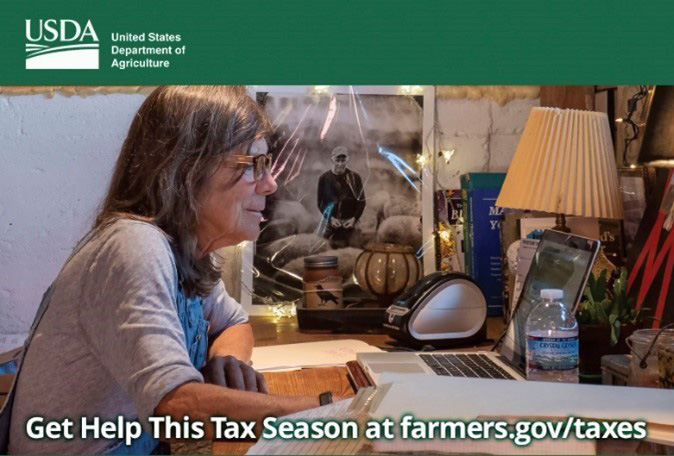
Tax time is a busy time of year for business owners, and this includes farmers and ranchers. Navigating filing your taxes can be challenging, especially if you are new to running a farm business, participated in disaster programs for first time, or are trying to forecast your farm’s tax bill. Receiving funds from USDA through activities such as a conservation program payment or a disaster program is considered farm income that includes a tax liability for farm businesses. 

To better support America’s farmers and ranchers USDA has partnered with tax experts from across the country to connect producers to information and resources related to USDA program payments, asset protection, and the important relationships between federal income taxes and USDA farm programs.


Upcoming Webinars

Event: Schedule F (Profit or Loss From Farming)
Date: Wednesday, March 22
Time: 3 p.m. Eastern
The Schedule F is used to report taxable income earned from farming, ranching, and agricultural activities. Join USDA and Guido van der Hoeven, President, Land Grant University Tax Education Foundation, Inc. (LGUTEF), for a line-by-line review of this tax form.

Register in advance for the webinar on March 22, 2023.


Thursday, March 9, 2023

USDA Announces Sign-up for Cost-Share Assistance for On-Farm Grain Storage in Areas with Limited Commercial Capacity Due to Severe Storms


New Program Helps Fill the Need Caused by Damaged Grain Storage Facilities in Kentucky, Minnesota, and South Dakota  

WASHINGTON, March 9, 2023 — Agriculture Secretary Tom Vilsack today announced that producers in counties affected by eligible disaster events in Kentucky, Minnesota, South Dakota, Illinois, Indiana, Iowa, Missouri, North Dakota, and Tennessee can apply for cost-share assistance through the Emergency Grain Storage Facility Assistance Program (EGSFP). The new program provides cost-share assistance for the construction of new grain storage capacity and drying and handling needs, in order to support the orderly marketing of commodities. An initial allocation of $20 million in cost-share assistance is available to agricultural producers in affected counties impacted by the damage to or destruction of large commercial grain elevators as a result of natural disasters from Dec. 1, 2021, to Aug. 1, 2022. The application period opens later this month and closes Dec. 29, 2023.   

“Weather events in 2021 and 2022 in several states caused catastrophic losses to grain storage facilities on family farms as well as a large, commercial grain elevator, leaving stored grain exposed to the elements and affecting storage and commodity marketing options for many producers,” Vilsack said. “USDA heard from congressional leaders, including Minority Leader McConnell, who identified a gap in our disaster assistance toolkit and used our Commodity Credit Corporation authority to act more quickly than waiting for specific legislation. This new program will provide cost-share assistance to help producers address their on-farm storage capacity needs that are necessary for marketing grain.”  

This assistance from USDA’s Farm Service Agency (FSA) is designed to help producers affected by the December 2021 tornadoes that passed through 11 counties in Kentucky, as well as producers in Illinois, Indiana, Iowa, Minnesota, Missouri, North Dakota, South Dakota, and Tennessee affected by eligible disaster events in 2022.  The program was previewed last fall and will be made available with the publication of the Notice in the Federal Register.   

Eligibility   

Maps showing the location of damaged grain facilities in Kentucky, Minnesota, South Dakota and surrounding eligible areas are available online. These maps depict damaged storage facility locations and the affected counties within a 30-mile radius of these facilities where producers may be eligible to apply for EGSFP benefits if they can demonstrate a need for additional on-farm grain storage capacity.     

Additionally, FSA may determine a need for EGSFP assistance in counties in other states and regions during the application period where an eligible disaster event has damaged storage facility locations. Eligible disaster events include hurricanes, tornadoes, floods, derechos, straight-line winds and winter storms that occurred between Dec. 1, 2021, and Aug. 1, 2022.   

EGSFP helps producers build permanent or temporary on-farm grain storage capacity, restore existing storage capacity, and purchase drying and handling equipment in affected counties.   

The following types of new/used facilities and upgrades are eligible for cost-share assistance and must have a useful life of at least three years:  

  • conventional-type cribs or bins designed and engineered for grain storage  
  • open buildings with two end walls  
  • converted storage structures  
  • asphalt, concrete or gravel floors with grain piles and tarp covering,  
  • ag baggers (including bags) 

On-farm grain storage structures may account for aeration, drainage, and may require loading or unloading augers, drying and handling equipment.    

How to Apply  

Producers must submit the EGSFP Application, form FSA-413, and any additional required forms to their FSA county office either in person, by mail, email, or facsimile starting later this month and by the Dec. 29, 2023, deadline. Form FSA-413-1, Continuation Sheet for EGSFP, must be submitted with the FSA-413 when a group of producers are applying for assistance.   

Payment Calculation  

FSA will use the producer’s self-certified cost of the additional on-farm grain storage capacity or drying and handling equipment needed multiplied by the producer’s share of grain.   

This amount will then be multiplied by the cost share factor of 75% or 90%. An eligible producer who certifies they are socially disadvantaged, limited resource, beginning and veteran farmer or rancher by filing form CCC-860 with FSA will receive the higher 90% cost share rate.   

More Information   

For more information visit the program webpage or the EGSFP fact sheet. USDA also has an existing Farm Storage Facility Loan Program that can immediately provide low-interest financing for eligible producers who may not be eligible for EGSFP but are in need of on-farm storage capacity.    

USDA touches the lives of all Americans each day in so many positive ways. In the Biden-Harris administration, USDA is transforming America’s food system with a greater focus on more resilient local and regional food production, fairer markets for all producers, ensuring access to healthy and nutritious food in all communities, building new markets and streams of income for farmers and producers using climate smart food and forestry practices, making historic investments in infrastructure and clean energy capabilities in rural America, and committing to equity across the Department by removing systemic barriers and building a workforce more representative of America. To learn more, visit usda.gov

USDA is an equal opportunity provider, employer and lender.

Wednesday, March 8, 2023

Texas A&M Online ‘Drought Proofing the Ranch’ course now available

  Management, drought mitigation strategies highlighted

MARCH 8, 2023

By  Susan Himes,  Susan.Himes@ag.tamu.edu 


The Texas A&M AgriLife Extension Service’s course Drought Proofing the Ranch is now available online.

(Texas A&M AgriLife photo by Sam Craft)

The cost is $100 however, the first 100 registrants will receive the course at no cost. The course is two hours, but participants may view it at their own pace. Register at https://tx.ag/DroughtProofingRanch.

“Participants will increase their understanding of drought management strategies,” said Morgan Treadwell, Ph.D., AgriLife Extension rangeland specialist, San Angelo. “Drought is an ever-present specter for Texas livestock and forage producers, and this course will help producers create plans for managing livestock and rangelands, specifically, brush and weeds with herbicides, during drought.”

With 8.7 million Texans currently impacted by drought, this course offers timely advice and guidance for those ranchers affected as well as for preparing for future occurrences.

“The course will help producers develop risk management strategies, identify the best risk management tools and recognize the importance of advanced preparation for when a drought occurs,” she said. “The goal is for producers to learn to identify drought conditions and to develop a plan to mitigate losses due to drought ahead of time.”

AgriLife Extension expert instructors, topics covered

The course is taught by Treadwell; Jason Smith, Ph.D., AgriLife Extension beef cattle specialist, Amarillo; Pancho Abello, AgriLife Extension economist, Vernon; and Justin Benavidez, Ph.D., former AgriLife Extension economist, Amarillo.

The topics the course will cover include:

  • Creating a Plan to Addresses Livestock Management During Drought.
  • Risk Management Products for Drought Mitigation: Forage and Livestock Insurance Options.
  • Nutritional and Other Management Strategies.
  • Rangeland Management and Wildfire Mitigation Strategies During Drought.
  • Economic Management Strategies to Minimize Drought Impact.
  • Evaluation Strategies for Feeding Through a Drought and Longer-Term Consequences.
  • Tax Implications for the Sale of a Large Number of Livestock.
  • Stocking Rate Adjustments and their Consequences.


Would you like more information from Texas A&M AgriLife?

Sign up for our Texas A&M AgriLife E-Newsletter

Tuesday, March 7, 2023

As rainfall patterns become more extreme, pasture managers will need to become increasingly proactive


A well-managed farm with buffers goes a long way
of slowing runoff and help infiltrate before
reaching a stream. (Image courtesy Dirk Philipp.)


By the U of A System Division of Agriculture 


Fast Facts: 

  • Rainfall intensity, frequency need to be taken into account when choosing forages 
  • Consider reforesting some areas based on topography 


 FAYETTEVILLE, Ark. — Average temperatures in Arkansas have risen about 0.5 degrees over the past two decades, according to the North Carolina Institute for Climate Studies. One result of this has been more extreme patterns of rainfall and drought. Dirk Philipp, associate professor of forage agronomy for the University of Arkansas System Division of Agriculture, said these changes in rainfall patterns typically have a variety of effects — particularly on agriculture.  


Based on current climate and weather patterns, Philipp said, these weather extremes may include increased rainfall intensity and extended periods of both higher and lower rain frequency, leading to flooding and drought, respectively — and these changes in rainfall patterns typically have a variety of effects. 


“For example, increased intensity means the rain has a higher impact on soil, which equates to higher erosion potential,” he said. “There’s a higher potential for runoff and dislodging soil particles.” 


Philipp said changes in rainfall patterns may also lead to decreased rainwater infiltration rates, meaning the soil itself will retain less moisture and aquifers will be slower to recharge. And because evaporation rates are high in the southeastern United States, droughty periods will be relatively more severe for plants in that region than in higher latitudes where incoming solar rays are less powerful. 


“Changing rainfall patterns also have biological effects,” Philipp said. “Planting times are affected, because fields may be wetter or drier than in the past during the usual planting times.” 


All of this will put stress on existing forage stands and will have implications for establishing new stands as well, Philipp said. To make pastures more resilient in the long term, he has several key suggestions. 


“Buffer strips in strategic locations go a long way in capturing runoff and helping to infiltrate it into the soil,” he said. “Extended riparian areas will also achieve that. Buffers around 50-100 feet wide can be grazed, as well.” 


Philipp said pasture managers should be conscious of the topography of their land, and should consider reforesting areas that were likely covered in woodlands before farming.  


“This doesn’t have to cover a lot of area, but if you can set aside a few acres, that will go a long way of keeping as much rainfall on your land as possible,” he said. 


Strategic choices
Philipp said producers should be strategic with their choice of forages, making their lands more resilient and lowering their economic risks. 


“For example, native perennial warm season grasses are drought resistant,” he said. “Plant them in areas that may get more affected by drought. Eastern gamagrass works well for wetter areas and is readily grazed by cattle. Placing cool season perennial forages, such as fescue or orchardgrass, alongside riparian zones will provide forage for spring and fall while decelerating runoff.” 


Riparian zones are where land and lakes or streams meet. 


Finally, Philipp said that whatever choices producers make initially, it’s important to remain flexible and realize they will need to further adapt over time. This can mean keeping more residual forage after a grazing event, avoiding prolonged stocking in late winter on cool season pastures and more. 


“Calculate your forage needs for summer grazing, and plan long-term for planting more areas in warm season annual and perennial forages,” he said. 


To learn about extension programs in Arkansas, contact your local Cooperative Extension Service agent or visit www.uaex.uada.edu. Follow us on Twitter and Instagram at @AR_Extension. To learn more about Division of Agriculture research, visit the Arkansas Agricultural Experiment Station website: https://aaes.uada.edu/. Follow on Twitter at @ArkAgResearch. To learn more about the Division of Agriculture, visit https://uada.edu/. Follow us on Twitter at @AgInArk. 


Monday, March 6, 2023

USDA Proposes New Requirements for the “Product of USA” Label Claim


Agency seeks comments on proposed rule

WASHINGTON, March 6, 2023 – The U.S. Department of Agriculture (USDA) today released a proposed rule with new regulatory requirements to better align the voluntary “Product of USA” label claim with consumer understanding of what the claim means. The proposed rule allows the voluntary “Product of USA” or “Made in the USA” label claim to be used on meat, poultry and egg products only when they are derived from animals born, raised, slaughtered and processed in the United States. Today’s announcement delivers on one of the key actions in President Biden’s Executive Order on Promoting Competitionin the American Economy, and a commitment made in the Biden-Harris Administration’s Action Plan for a Fairer, More Competitive, and More Resilient Meat and Poultry Supply Chain. The increased clarity and transparency provided by this proposed change would prevent consumer confusion and help ensure that consumers understand where their food comes from.


“American consumers expect that when they buy a meat product at the grocery store, the claims they see on the label mean what they say,” said Agriculture Secretary Tom Vilsack. “These proposed changes are intended to provide consumers with accurate information to make informed purchasing decisions. Our action today affirms USDA’s commitment to ensuring accurate and truthful product labeling.”


USDA’s proposed rulemaking is supported by petitions, thousands of comments from stakeholders, and data. In July 2021, USDA initiated a comprehensive review to understand what the “Product of USA” claim means to consumers and inform planned rulemaking to define the requirements for making such a claim. As part of its review, USDA commissioned a nationwide consumer survey. The survey revealed that the current “Product of USA” labeling claim is misleading to a majority of consumers surveyed, with a significant portion believing the claim means that the product was made from animals born, raised, slaughtered and processed in the United States.


USDA’s comprehensive review shows there is a clear need to revise the current “Product of USA” label claim so that it more accurately conveys U.S. origin information.


Under the proposed rule, the “Product of USA” label claim would continue to be voluntary. It would also remain eligible for generic label approval, meaning it would not need to be pre-approved by USDA’s Food Safety and Inspection Service (FSIS) before it could be used on regulated product, but would require supporting documentation to be on file for agency inspection personnel to verify. The rulemaking also proposes to allow other voluntary U.S. origin claims we see on meat, poultry and egg products sold in the marketplace. These claims would need to include a description on the package of all preparation and processing steps that occurred in the United States upon which the claim is made.


USDA encourages stakeholders, both domestic and international, to comment on the proposed rule. The proposed rule will be open for public comment for 60 days after publishing in the Federal Register. Public comments can be submitted at www.regulations.gov.


USDA touches the lives of all Americans each day in so many positive ways. In the Biden-Harris Administration, USDA is transforming America’s food system with a greater focus on more resilient local and regional food production, fairer markets for all producers, ensuring access to safe, healthy, and nutritious food in all communities, building new markets and streams of income for farmers and producers using climate smart food and forestry practices, making historic investments in infrastructure and clean energy capabilities in rural America, and committing to equity across the Department by removing systemic barriers and building a workforce more representative of America. To learn more, visit www.usda.gov.

Friday, February 17, 2023

USDA Announces Conservation Reserve Program Signup for 2023


WASHINGTON, Feb. 16, 2023 – Agriculture Secretary Tom Vilsack announced that agricultural producers and private landowners can begin applying for the Conservation Reserve Program (CRP) General signup starting February 27 through April 7, 2023. CRP is a cornerstone voluntary conservation program offered by the U.S. Department of Agriculture (USDA) and a key tool in the Biden-Harris administration’s effort to address climate change and help agricultural communities invest in the long-term well-being of their land and natural resources.  

“The Conservation Reserve Program is one of the largest private lands conservation programs in the United States, offering a range of conservation options to farmers, ranchers and landowners,” Vilsack said. “CRP has and continues to be a great fit for farmers with less productive or marginal cropland, helping them re-establish valuable land cover to help improve water quality, prevent soil erosion, and support wildlife habitat. Under this administration, we have made several updates to the program to increase producer interest and enrollment, strengthen the climate benefits of the program and help ensure underserved producers can find a pathway to entry into CRP.”  

Producers and landowners enrolled more than 5 million acres into CRP through signups in 2022, building on the acceptance of more than 3.1 million acres in the largest Grassland CRP signup in history. There are currently 23 million acres enrolled in CRP, with 1.9 million set to expire this year. USDA’s Farm Service Agency (FSA) is aiming to reach the 27-million-acre cap statutorily set for fiscal year 2023.  

General CRP 

General CRP helps producers and landowners establish long-term, resource-conserving plant species, such as approved grasses or trees, to control soil erosion, improve water quality and enhance wildlife habitat on cropland. Additionally, General CRP includes a Climate-Smart Practice Incentive to help increase carbon sequestration and reduce greenhouse gas emissions by helping producers and landowners establish trees and permanent grasses, enhance wildlife habitat, and restore wetlands.  

Continuous CRP 

Under Continuous CRP, producers and landowners can enroll in CRP throughout the year. Offers are automatically accepted provided the producer and land meet the eligibility requirements and the enrollment levels do not exceed the statutory cap. The Climate-Smart Practice Incentive is also available in the Continuous signup.  

FSA offers several additional enrollment opportunities within Continuous CRP, including the Clean Lakes Estuaries and Rivers Initiative (CLEAR30), the State Acres for Wildlife Enhancement (SAFE) Initiative, the Farmable Wetlands Program (FWP), and the Conservation Reserve Enhancement Program (CREP). The CLEAR30 Initiative, which was originally piloted in twelve states in the Great Lakes and Chesapeake Bay watershed, has been expanded nationwide, allowing producers and landowners to enroll in 30-year CRP contracts for water quality practices. Under this administration, FSA also moved SAFE practices back to the Continuous CRP signup, giving producers and landowners more opportunities to participate in the initiative. Through the FWP, producers and landowners can enroll land in CRP as part of their efforts to restore previously farmed wetlands and wetland buffers, to improve both vegetation and water flow.  

This administration has also made significant improvements to CREP, which leverages federal and non-federal funds to target specific State, regional or nationally significant conservation concerns. Specifically, USDA made significant improvements to CREP to reduce barriers and make the program more accessible to a broad range of producers and new types of partners. These updates included flexibility for partners to provide matching funds in the form of cash, in-kind contributions, or technical assistance, along with an investment in additional staff to work directly with partners. Through CREP, for the first time ever, three Tribal Nations are now partnering with USDA to help conserve, maintain, and improve grassland productivity, reduce soil erosion, and enhance wildlife habitat.  

Grassland CRP 

FSA will announce the dates for Grassland CRP signup in the coming weeks. Grassland CRP is a working lands program, helping landowners and operators protect grassland, including rangeland and pastureland and certain other lands, while maintaining the areas as working grazing lands. Protecting grasslands contributes positively to the economy of many regions, provides biodiversity of plant and animal populations, and provides important carbon sequestration benefits to deliver lasting climate outcomes.   

How to Sign Up 

Landowners and producers interested in CRP should contact their local USDA Service Center to learn more or to apply for the program before their deadlines.  

Producers with expiring CRP acres can use the Transition Incentives Program (TIP), which incentivizes producers who sell or enter a long-term lease with a beginning, veteran, or socially disadvantaged farmer or rancher who plans to sustainably farm or ranch the land. 

More Information 

Signed into law in 1985, CRP is one of the largest voluntary private-lands conservation programs in the United States. It was originally intended to primarily control soil erosion and potentially stabilize commodity prices by taking marginal lands out of production. The program has evolved over the years, providing many conservation and economic benefits.   

USDA touches the lives of all Americans each day in so many positive ways. Under the Biden-Harris administration, USDA is transforming America’s food system with a greater focus on more resilient local and regional food production, fairer markets for all producers, ensuring access to safe, healthy and nutritious food in all communities, building new markets and streams of income for farmers and producers using climate smart food and forestry practices, making historic investments in infrastructure and clean energy capabilities in rural America, and committing to equity across the Department by removing systemic barriers and building a workforce more representative of America. To learn more, visit usda.gov. 

USDA is an equal opportunity provider, employer and lender.