|
|
|
|
Washington, DC 20250
FPAC.BC.Press@usda.gov
WASHINGTON, Oct. 4, 2024 – In the aftermath of Hurricane Helene, which devastated communities, homes, farms and businesses across parts of the Southeast, the U.S. Department of Agriculture (USDA) has deployed staff to assist with response and recovery efforts. USDA is also putting in place contingency plans and program flexibilities to ensure farmers, and foresters and communities are able to get the support they need. USDA is sharing information today to help impacted people learn about resources that may be available to them.
On Thursday, Agriculture Secretary Tom Vilsack and Farm Service Agency Administrator Zach Ducheneaux traveled to Florida and Georgia with President Biden to assess damage and meet with farmers and residents in the wake of the storm. In remarks, Secretary Vilsack highlighted that USDA is taking measures like extending program signup opportunities and using waivers and emergency procedures to expedite recovery efforts on America’s working lands. The department has also deployed 190 staff, including many from the U.S. Forest Service, to assist with response efforts, including removal of debris from roads.
“At USDA, our thoughts and prayers go out to all the families and farmers who have been impacted by this storm,” said Agriculture Secretary Tom Vilsack. “Our job is to try to keep farms viable and operational, to help rural communities remain resilient, and at the end of the day to get as much help as quickly as possible to as many people as possible.”
Here are steps USDA wants farmers to know about to ensure they can access the tools and resources that USDA offers:
How to Contact USDA
USDA has offices in virtually every county. However, some remain obstructed or without power due to the storm. Other USDA offices in affected states are stepping up to help triage and take producers’ calls. The Farm Service Agency Call Center, available at 877-508-8364, can help direct producers to available staff. More program information is also farmers.gov.
Leaders with USDA’s Farm Service Agency (FSA), Natural Resources Conservation Service (NRCS), and Risk Management Agency (RMA) will hold a virtual briefing on Monday, Oct. 7 at 11 a.m. EDT for agricultural producers and stakeholders to share information on disaster assistance programs for agricultural operations. Visit farmers.gov/hurricane for details on how to join.
Through the Farm and Ranch Stress Assistance Network, USDA also partners with several organizations to offer mental health resources. Anyone in need of extra support in light of stressful circumstances is encouraged to contact the Southern Ag Exchange Network Farmer Support Hotline at 888-381-7243, which is available 24/7.
Expediting Crop Insurance Payments
USDA estimates there are more than 38,000 crop insurance policies, covering more than 4.8 million acres, in place in the affected areas. USDA has instructed crop insurance companies to expedite loss adjustments that are necessary to make payments, and we expect payments to be made within 30 days. If you have Federal crop insurance, contact your crop insurance agent as soon as crop or livestock losses are apparent.
Documenting and Reporting Losses
USDA reminds producers to document damages and losses, including gathering farm records, herd inventory, receipts and pictures of damages or losses. USDA advises livestock producers to document livestock numbers by taking time and date-stamped video or pictures of injury or loss, to the extent possible. USDA asks producers to report crop, livestock and farm infrastructure losses to FSA at your local USDA Service Center. Producers can call the FSA Hotline for assistance if their local Service Center is currently closed.
Flexibilities for Disaster Assistance Programs
In addition to RMA’s Federal crop insurance flexibilities, FSA has added flexibilities to several programs. A full list of FSA disaster assistance programs is available on the Hurricane webpage on farmers.gov.
To help expedite assistance through the Emergency Conservation Program (ECP) and Emergency Forest Restoration Program (EFRP), FSA has taken the following measures:
Additionally, the Livestock Indemnity Program (LIP) provides benefits to livestock owners and contract growers for livestock deaths in excess of normal mortality caused by eligible loss conditions including eligible adverse weather. FSA has issued guidance to FSA County Committees and local staff to exercise maximum flexibility in determining acceptable loss documentation and to ensure LIP applications are acted on timely.
Through the Emergency Assistance for Livestock, Honeybees, and Farm-Raised Fish Program (ELAP), FSA provides assistance to owners of livestock, and producers of honeybees and farm-raised fish for feed and death losses due to an eligible natural disaster event. FSA is providing assistance to help cover above normal costs to transport livestock to feed and/or transport feed/forage to livestock in hurricane-impacted states, and assistance to help cover above normal costs to haul water to livestock in hurricane-impacted states.
The Tree Assistance Program (TAP) provides financial cost-share assistance to qualifying orchardists and nursery tree growers to replant or, where applicable, rehabilitate eligible trees, bushes and vines lost by natural disasters. FSA has extended assistance to trees, bushes and vines that have not died but are no longer capable of production (not economically viable). This assistance program complements the Noninsured Crop Disaster Assistance Program (NAP) or federal crop insurance coverage, which covers the crop but not the plants or trees in all cases.
Under NAP, FSA has waived the 72-hour notification requirement on hand harvested crops, extended deadline to file a Notice of Loss, and provided flexibility for FSA staff to perform loss adjustment activities and/or waive field inspections in cases where the cause of loss can be verified through other means.
For producers with Marketing Assistance Loans (MAL), FSA is providing additional time for producers to deliver commodities to a buyer to repay MALs with sale proceeds and postponing MAL foreclosure letters applicable to losses or damages due to hurricanes for up to 90 calendar days.
A full list of FSA disaster assistance programs is available on the Hurricane webpage on farmers.gov.
USDA’s Natural Resources Conservation Service (NRCS) also offers recovery options for producers through the Environmental Quality Incentives Program (EQIP) and for communities through the Emergency Watershed Protection Program (EWP). Learn more on the NRCS Disaster Recovery webpage.
Nutrition Assistance
USDA’s Food and Nutrition Service, at states’ request, has already issued flexibilities and waivers at the for its many nutrition programs in Florida, Georgia, Kentucky, Ohio, North Carolina, South Carolina, Tennessee, Virginia, and West Virginia, in order to help emergency meal providers reach more people quickly. USDA is ready to issue additional flexibilities upon request. More information on those recovery and assistance efforts can be found on the FNS Disaster Assistance webpage.
More Information
Additional USDA disaster assistance information can be found on farmers.gov, including the Disaster Assistance Discovery Tool, Disaster-at-a-Glance fact sheet, Loan Assistance Tool, and Natural Disasters and Crop Insurance fact sheet. Additionally, FarmRaise offers an FSA educational hub with LIP and ELAP decision tools as well as farm loan resource videos.
USDA Rural Development is already communicating with local governments about how their resources can help assist with the long-term recovery of impacted rural communities. Additionally, Rural Development is looking at flexibilities within existing programs for communities impacted to address housing assistance for tenants and homeowners, water infrastructure needs, support to rural businesses, and existing participants of our Electric and Community Facilities programs. Additional information for impacted rural communities and current Rural Development customers can be found on the Rural Development Disaster Assistance site.
USDA touches the lives of all Americans each day in so many positive ways. Under the Biden-Harris administration, USDA is transforming America’s food system with a greater focus on more resilient local and regional food production, fairer markets for all producers, ensuring access to safe, healthy and nutritious food in all communities, building new markets and streams of income for farmers and producers using climate smart food and forestry practices, making historic investments in infrastructure and clean energy capabilities in rural America, and committing to equity across the Department by removing systemic barriers and building a workforce more representative of America. To learn more, visit usda.gov.
|
![]() |
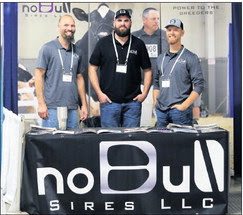
From left, Ben Masemore, Ethan Wentworth and Rusty Herr.
Wentworth and Herr are currently in jail afterfacing accusations
of practicing veterinary medicine without a license.
(Photo provided by Ben Masemore)
(Editor's Note: This action taken by Pennsylvania prosecutors should concern goat producers who routinely use ultrasound to determine pregnancy. They can potentially be charged with illegally practicing veterinary medicine. This article is reprinted from the April 20 e-edition of Lancaster Farming (lancasterfarming.com)
By Tom Venesky
Two Pennsylvania men operating a dairy reproduction service are in prison following a complaint of practicing veterinary medicine without a license. Rusty Herr, 43, was booked at the Lancaster County Prison on April 11, while Ethan Wentworth, 33, was sent to the York
County Prison on April 10. Herr and Wentworth are listed as operating partners of Airville-based NoBull Solutions LLC.
Veterinarians have made multiple complaints about “the illegal practice of veterinary medicine by unlicensed individuals employed by NoBull Solutions,” according to a complaint filed with the Department of State in 2020 by thePennsylvania Veterinary Medicine Association.
The complaint alleges that people employed by NoBull were doing ultrasounds and making diagnoses. The document cites reports from veterinary association members and posts on Facebook.
In 2010, Herr was ordered to pay a $3,500 fine and to cease and desist from the unlicensed practice of veterinary medicine. Wentworth got a cease-and-desist order in 2018 along with a $3,000 civil penalty. The 2020 complaint alleges that Herr and Wentworth continued to practice veterinary medicine without a license and hired others to do the same. According to dairy farmer Ben Masemore, who is acting as a spokesman for Herr and Wentworth, both men were advised by their former attorneys not to pay the fines or appear in court because they don’t see an issue with using ultrasound for reproductive services such as pregnancy checks. He said they are both serving 30-day sentences without bail.
Masemore, who is involved with Herr and Wentworth in an unrelated business, said the law governing veterinary practice is vague and doesn’t cover ultrasounding, which is a common practice on dairy farms today.
“I know of up to 20 individuals in the state using ultrasound for reproduction. Anyone can purchase one, as they are readily available today,” he said. Numerous dairy farmers in Lancaster, Lebanon, York and surrounding counties depended on the services offered by NoBull, and the operators’ detention has caused problems for those farms, Masemore said.
The Pennsylvania Veterinary Medicine Association deferred comment to the Department of State, which said it couldn’t confirm or deny an investigation due to confidentiality statutes. A search of Pennsylvania Licensing System Verification didn’t turn up any veterinary license records for Herr and Wentworth.
“The department reviews every potential practice act violation of which it becomes aware, whether that is through a complaint filed directly to the department, a notification from local law enforcement, or through media reports,” State Department spokeswoman Amy Gulli said in an email.
If the State Board of Veterinary Medicine is going to interpret ultrasounding as practicing medicine, the law needs to be changed, Masemore said.
“This really affects every single one of us (dairy farmers). With the economic situation of Pennsylvania dairy, we need all the help we can get,” Masemore said. “It’s not easy out there, and people need to change the way that dairy in Pennsylvania is being treated. We’re being tarred and feathered economically,and the burden keeps getting worse.” A recording on the phone line listed for NoBull Solutions said that due to the legal situation and staff shortages, the business is not scheduling herd checks or horse services before May 20.
The message urges callers to contact the state veterinary board and local lawmakers to express their concerns about the situation. A “NoBull Solutions LLC Defense Fund” has been set up for the men on GiveSendGo and at local banks. For more information, call 717-887-6465.
![]() |
Goat producers, industry stakeholders join Commissioner at proclamation signing.
Kentucky goat producers and industry stakeholders joined Commissioner of Agriculture Jonathan Shell April 12 as he signed a proclamation declaring April as Goat Month in Kentucky.
“The diversity of goats on our agricultural landscape is one that needs to be celebrated, particularly this month,” Commissioner Shell said. “Not only do they add a uniqueness to farm life, but they are also an excellent source of protein and dairy products. This month we salute all that goats add to our state’s agricultural outlook.”
In the United States, goats are primarily used for producing dairy products, such as milk, yogurt, and cheese, and meat called chevon. Kentucky has 5,300 dairy goats producing quality breeding stock, and healthy, all natural skin products like soaps and lotions. The popularity of goat meat is increasing each year as consumers recognize its benefits. Goat meat is lean with low levels of saturated fat and cholesterol, high levels of iron, and packed with proteins and vitamins. Kentucky ranks sixth in the nation for meat goat inventory with 59,000 head. The meat goat inventory has increased 5.4 percent since 2023, being produced by 4,000 farmers.
In addition to their nutritious value, goats can increase property values. Across the world, farmers use them to combat noxious weeds on their property, promote healthy forests, and prevent wildfires.
“Kentucky continues to be a leader in goat production because of our abundant forages and best management practices. Over 4,000 goat producers work very hard to produce high quality products for consumers,” said Kelley Yates, executive director of the Kentucky Sheep and Goat Development Office. “We are excited to showcase the versatility of goats in Kentucky during the month of April and hope more people learn of their benefits and impact in our state.”
The Kentucky goat industry adds more than $3.5 million in revenue to Kentucky’s agriculture receipts. Warren County is the top county in goat production with nearly 2,800 head, followed by Crittenden, Barren, Clinton, and Nelson counties rounding out the top five.
A variety of goat products can be found at local farmers’ markets or consumers can purchase directly from a producer. The Kentucky Sheep and Goat Development Office offers information on its website with tips for cooking this lean, delicious meat. The website also offers a buyer's guide at: https://www.kysheepandgoat.org/on-your-plate.
|