Friday, March 29, 2019

Nebraska Extension Offers Resources to Flood Victims


As Nebraskans begin returning to their homes in the aftermath of widespread historic flooding, Nebraska Extension has mobilized a number of resources to aid in the road to recovery.
Those affected by the flood are likely unsure of where to begin. Extension encourages individuals returning to homes and properties to first take steps to ensure their safety. When a home or building is flooded, there is likely damage to the structure. Buildings need to be thoroughly dried and it is critical to test domestic wells for bacteria. Also, be cautious when working in and around contaminated floodwater.
Extension has compiled a list of the state’s certified public health environmental laboratories where homeowners can obtain a water test kit.  
To read the article about flood resources, visit the KTIC radio website.
NIFA supports the Nebraska Extension Service.

Thursday, March 14, 2019

Property rights of landowners explained in March 20 webinar


By Sarah Cato
U of A System Division of Agriculture 

Fast facts
·       National Agricultural Law Center webinar will cover legal rights of landowners
·       Webinar is March 20 from noon to 1p.m. EST/11 a.m. to noon CST


The National Agricultural Law Center will host a webinar Wednesday, March 20, answering questions on property rights, rights-of-way, and eminent domain. Sean High, staff attorney for the Penn State Center for Agricultural and Shale Law, will help landowners understand the laws affecting these issues.

In addition to general property rights common to all landowners, this webinar will also cover right-of-way agreements and potential considerations for negotiation. The topic of eminent domain will also be discussed regarding a powerline or pipeline company’s right under federal and state law to seize private land.

“We commonly receive questions from stakeholders around the nation about pipeline and powerline easements, eminent domain, and right of way agreements,” said Harrison Pittman, director of the National Agricultural Law Center. “It’s an issue that often impacts farmers and other agriculturalists, and this webinar will address their concerns.”


For more information on upcoming webinars, visit https://nationalaglawcenter.org/.

About the National Agricultural Law Center
The National Agricultural Law Center serves as the nation’s leading source of agricultural and food law research and information. The Center works with producers, state and federal policymakers, Congressional staffers, attorneys, land grant universities, and many others to provide objective, nonpartisan agricultural and food law research and information to the nation’s agricultural community.
The Center is a unit of the University of Arkansas System Division of Agriculture and works in close partnership with the USDA Agricultural Research Service, National Agricultural Library.
About the Division of Agriculture 
The University of Arkansas System Division of Agriculture’s mission is to strengthen agriculture, communities, and families by connecting trusted research to the adoption of best practices. Through the Agricultural Experiment Station and the Cooperative Extension Service, the Division of Agriculture conducts research and extension work within the nation’s historic land grant education system. 

The Division of Agriculture is one of 20 entities within the University of Arkansas System. It has offices in all 75 counties in Arkansas and faculty on five system campuses.  

The University of Arkansas System Division of Agriculture is an equal opportunity/equal access/affirmative action institution. If you require a reasonable accommodation to participate or need materials in another format, please contact 479-575-4607 as soon as possible. Dial 711 for Arkansas Relay. 


Monday, March 11, 2019

USDA Seeks Public Comments on Conservation Practice Standards


March 11, 2019, WASHINGTON – USDA’s Natural Resources Conservation Service (NRCS) announced today it is seeking public input on its existing national conservation practice standards as part of implementing the 2018 Farm Bill. NRCS offers 150-plus conservation practices to America’s farmers, ranchers and forest landowners to help them meet their business and natural resource needs on their working lands.

“With the help of NRCS, agricultural producers across the country are taking voluntary steps to improve their operations while benefiting natural resources,” NRCS Chief Matthew Lohr said. “As part of our process of implementing the 2018 Farm Bill, we are asking agricultural producers, conservation partners and others to provide feedback on our practice standards in an effort to refine and enhance them.”

NRCS is requesting public comments on how to improve conservation practice standards that support programs such as the Environmental Quality Incentives Program and Conservation Stewardship Program, which help producers cover part of the costs for implementing these practices. The comment period ends April 25, 2019. More information can be found in the Federal Register.

These standards provide guidelines for planning, designing, installing, operating and maintaining conservation practices.


2018 Farm Bill

As part of implementing the 2018 Farm Bill, NRCS is reviewing conservation practices by:

•    Evaluating opportunities to increase flexibility while ensuring natural resource benefits.
•    Seeking avenues for the optimal balance between meeting site-specific conservation needs and minimizing risks of design failure and associated construction and installation costs.
•    Ensuring, to the maximum extent practicable, the completeness and relevance of the standards to local agricultural, forestry and natural resource needs, including specialty crops, native and managed pollinators, bioenergy crop production, forestry and others.


Providing Comments

Comments may be submitted using any of the following methods:

•    Federal eRulemaking Portal: http://www.regulations.gov. Follow the instructions for submitting comments.
•    Mail or hand-delivery: Public Comments Processing, Attention: National Environmental Engineer, Natural Resources Conservation Service, United States Department of Agriculture, 1400 Independence Avenue SW, Room 6130-S, Washington, DC 20250.

NRCS will use comments as part of updating standards. For more information on how NRCS is implementing the Farm Bill, visit farmers.gov/farmbill. 


Tuesday, March 5, 2019

Webinar: Don't Let the Barber Pole Worm Ravage Your Flock


The Barber Pole Worm represents an increasing threat to sheep and goat producers, especially those on Western irrigated pastures. This webinar, led by Dave Scott, NCAT Livestock Specialist, focuses on holistic management of the Barber Pole Worm in irrigated settings in the Inter Mountain West.
FAMACHA scoring to create refugia, strategic grazing techniques, and simple genetic strategies to increase host resistance will be highlighted.
If you have any questions you would like answered during the webinar, you can send them in advance to daves@ncat.org
Date: Thursday, March 14

Time: Noon to 1 p.m. MDT

Since 1976, the National Center for Appropriate Technology (NCAT) has been helping people by championing small-scale, local and sustainable solutions to reduce poverty, promote healthy communities and protect natural resources. More information about its programs and services is available at www.ncat.org or by calling 1-800-ASK-NCAT.

Follow NCAT on FacebookFollow NCAT on TwitterFollow NCAT on LinkedIn
Copyright © 2019
The National Center for Appropriate Technology


NCAT Western mailing address:
P.O. Box 2218
Davis, CA 95617
1-800-ASK-NCAT

Please consider a donation to NCAT. Your support helps NCAT promote sustainable solutions.

Become an E-news Subscriber


THE NCAT MISSION
Helping people by championing small-scale, local, and sustainable solutions to reduce poverty, promote healthy communities, and protect natural resources.

Friday, March 1, 2019

Kentucky State Third Thursday Goat Program March 21

March Third Thursday program will be March 21 starting at 10 am on the HR Benson Research and Demonstration Farm.  The agenda is attached.  The program like always is open to the public and free of charge. 

The morning will focus on funding source for projects and improvements that are available.  Spring is a time of year when many of the programs are open for application and would be a good opportunity for producers to look at finding possible funding sources to help make improvements for pasture management and other aspects on their farms.

The afternoon will start with a producer presentation on grazing browse as a commercial operation and experiences with it. There has been growing interest in this type of grazing on personal property and as a business.  There are some aspects of this that people need to be aware of when working to utilize this type of grazing for their animals as well as for a business.

We will also have a presentation on pasture recovery after this winter.  We all have greater pasture damage this year than most and it is important to get new forages established and address fertility and other soil concerns correctly as spring arrives.  This will be a panel discussion and the panel members are still being finalized but we will cover management, soil, and forages in this discussion.

The last presentation of the day will be on quality assurance for goats and sheep.  It will cover what this critical topic is and why everyone should be practicing it.  It will cover proper injection cites and practices as well as assessment of animals.  There will be a small hands on part to this presentation so have your questions and we will get them answered.

Ken Andries, Ph.D.
Associate Professor, Animal Science
College of Agriculture, Communities, and the Environment
Kentucky State University
CEB 105/113
Office: 502-597-5094
Cell: 502-229-8719


Goat Third Thursday
TIME
PROGRAM
10:00 - 10:15 am
Welcome and Announcements 
Dr. Marion Simon, Kentucky State University
10:15 – 10:50 am
“GOAP Program for Producers”
Warren Beeler, Kentucky Department of Agriculture
11:00 – 11:50 am
“KCARD”
Katie Bowman, Kentucky Center for Agriculture and Rural Development

“KSU Small Producer Grant Program”
Joni Nelson, Kentucky State University
12:00 – 1:00 pm
Lunch
KSU Farm Crew
1:00 – 1:50 pm
“Browse Programs and Grazing for Brush Control”
David Neville and Al Dilley
2:00 – 2:50 pm
“Discussion on Pasture Recovery”
Dr. Ken Andries, Kentucky State University and others
3:00 – 3:50 pm
“Small Ruminant Quality Assurance”
Emily Clement and Amber Hartell, Kentucky State University
    
PLEASE NOTE:  The next Third Thursday Thing Program will be April 25, 2019. 
Educational programs of Kentucky Cooperative Extension serve all people regardless of economic or social status and will not discriminate on the basis of race, color, ethnic origin, national origin, creed, religion, political belief, sex, sexual orientation, gender identity, gender expression, pregnancy, marital status, genetic information, age, veteran status, or physical or mental disability. Kentucky State University, University of Kentucky, U.S. Department of Agriculture, and Kentucky Counties, Cooperating. 2017

Friday, February 15, 2019

Nebraska lambing and kidding school March 2

The Nebraska Sheep and Goat Producers Association and Nebraska Extension are hosting a lambing kidding school, Saturday March 2nd, 10am at the Custer County Fairgrounds. The school consists of 6 presentations and a hands-on tour.
Presentations include:
“How to keep ewes and does healthy through disease control and treatment” presented via webinar by Dr. Brian Vander Ley, DVM and Veterinary Epidemiologist at the UNL Great Plains Veterinary Educational Center
“Economical Feeding programs for the doe” presented by Dr. Steve Hart, Goat Extension Specialist with Langston University, Tulsa, OK
“Movi bacteria and how to prevent it in sheep herds” presented by Laura McHale, Wildlife Biologist with South Dakota State University 
“Economical Feeding programs for the ewe” presented by Dr. Ivan Rush, sheep producer, Scottsbluff, NE
“Good Sheep Management Practices” presented by David Ollila, Sheep Specialist, SDSU Rapid City, SD   
“Treating Chilled Newborns” presented by Dr. Regina Rankin, DVM, and Vicki Milner, Crawford Companion Animal Clinic
The Tour includes: body condition of ewes and does, care of the young “bum” lamb and goat, when and how to assist difficult births, and other health and management practices.
Join us Saturday, March 2nd, 10am at the Custer County Fairgrounds, 44100 Memorial Dr. Broken Bow, NE. The Cost is $25 for non-members, $20 for members, and $10 for students. Handouts and Lunch Included. To register email ne.sheep.goat@gmail.com or Call Melissa Nicholson at 308-386-8378 by February 27th. 


Wednesday, February 13, 2019

The Founding Farmers


Posted by Justin Fritscher, USDA in Farming ConservationFeb 12, 2019
From Mount Vernon to Monticello, many of the key conservation practices that USDA recommends producers use on their farms have roots with our “founding farmers,” from presidents like George Washington, Thomas Jefferson, and Abraham Lincoln, to innovators like Ben Franklin and George Washington Carver. 
The political and thought leaders of the young nation knew how important agriculture and – more importantly, sustainable agriculture – was to America’s success. They wrote about how to grow enough food to feed a booming population, how to boost soil health, and how to farm in a way that prevents soil erosion. 
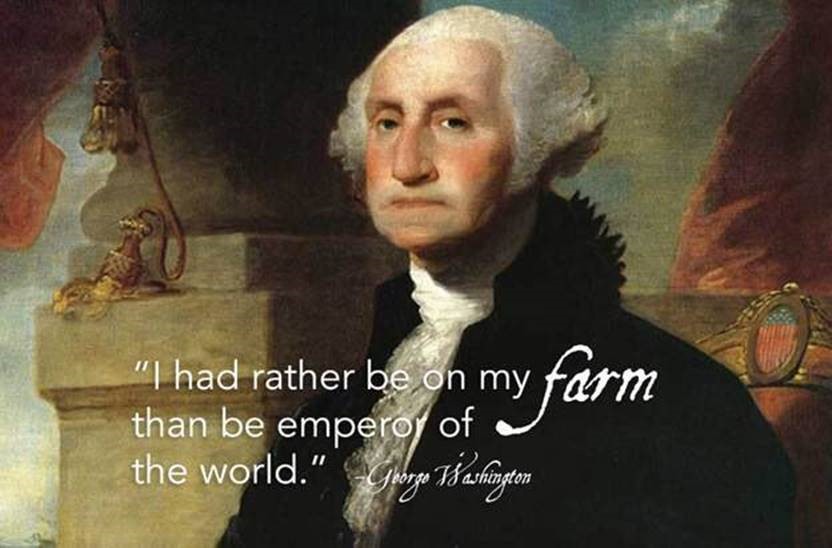
"I had rather be on my farm than be emperor of the world." -George Washington
A Farmer First
Historian Garry Wills said: “Farming technique was Washington’s principal intellectual discipline, his favorite topic of conversation, the focus of his private correspondence.”
Actually, when British troops closed in on New York City in 1776, then General George Washington temporarily put aside his battle plans to pen a letter to the steward of Mount Vernon about his farm.
The “First” Crop Experiment Stations
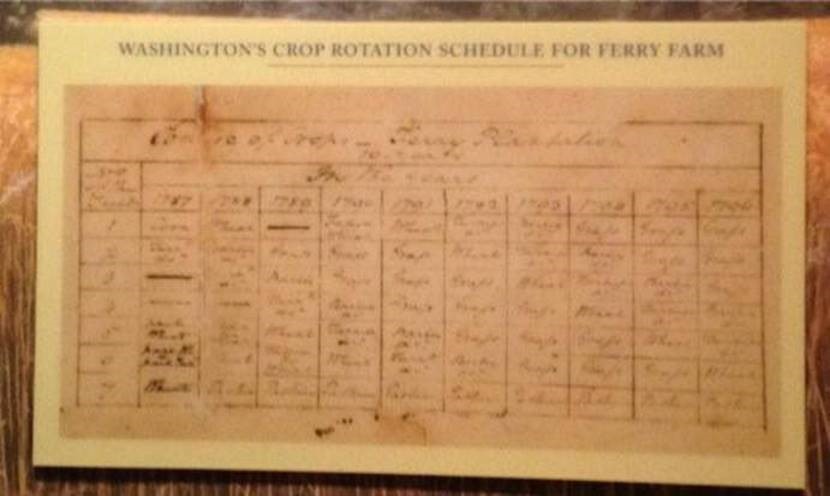
Washington studied and implemented ways to improve his farming methods at Mount Vernon, his 8,000-acre homestead and network of farms in Virginia near Washington, D.C. He took meticulous notes, and he experimented quite often. As did Thomas Jefferson, the nation’s third president, who was known for hundreds of varieties of fruits, vegetables, and herbs grown at Monticello located near Charlottesville, Virginia. 
With everything so unstudied – soils, weather, crops, pests, weeds, and farming methods – the founding farmers ran unofficial demonstration farms. Benjamin Franklin, although known for his inventions, bought a New Jersey farm where he retired, managing it like a “miniature experiment station, carrying on projects in drainage, in crop rotation, and especially in the utilization of the newer grasses and liming and fertilization,” wrote historian Earle D. Ross.
And of Washington, historian Albert Bushnell Hart wrote: “He established what I believe to have been the first agricultural experiment station in American history.”
Of Washington, historian Albert Bushnell Hart wrote: “He established what I believe to have been the first agricultural experiment station in American history.”
Early Conservationists
Unknowingly, these founding farmers were among the earliest proponents of soil health in America, as they used crop rotations and organic fertilizers to boost soil health and production. Actually, many of the farming methods implemented on their farms align with conservation practices that USDA recommends to farmers today. 
Ten years after the republic was born, Washington began to reconfigure fields on his farms, changing from a one-crop tobacco system to a seven-crop system growing wheat, corn, and legumes. Wheat was the principal cash crop; corn fed his livestock, and legumes fed the soil.  
America’s fifth president, James Monroe, was also a farmer, who left tobacco for a multi-crop system of grains. Historian Harlow Giles Unger wrote: “To keep his fields fertile, he rotated his crops, setting some fields aside for a season of clover…to revitalize the soil.”
Not Going Out of Style
Conservation crop rotation is one of the 100-plus conservation practices that USDA’s Natural Resources Conservation Service helps farmers plan and implement because of its many benefits to soil and production. 
Similarly, contour farming and cover crops, which were found on farms on the early days of our republic, are still used today. 
While traveling in France, Jefferson saw that farmers planted to the contour of the land rather than in straight lines. He wrote: “Our country is hilly, and we have been in the habit of ploughing in straight rows… and our soil was rapidly running into rivers.” He used contour farming at Monticello, putting him ahead of his contemporaries.
And Washington’s cropping systems included cover crops to prevent erosion and improve soil. Mount Vernon researcher Jinny Fox wrote: “He rotates crops – first he tries buckwheat and later switches to clover.”
Help for Farmers
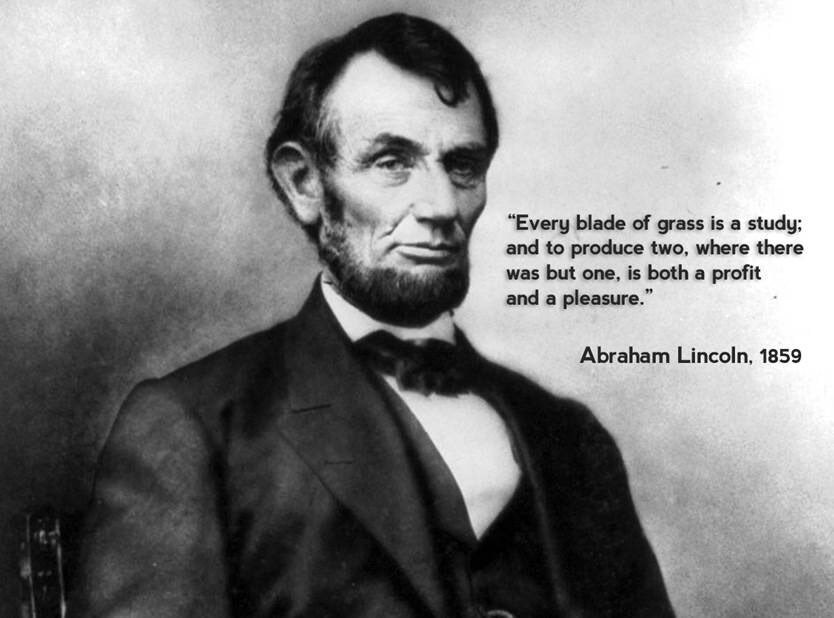
Raised on a farm in Indiana and Illinois, who would know better than farmer-turned-president, Abraham Lincoln, about the importance of the government supporting agriculture. Lincoln advocated for the creation of USDA and signed the legislation that created it.  
“Every blade of grass is a study; and to produce two, where there was but one, is both a profit and a pleasure.” -Abraham Lincoln
More than 150 years later, USDA offers a variety of risk management, disaster, loan, and conservation programs to help agricultural producers build resiliency and weather ups and downs in the market.
For more information on conservation practices – including conservation crop rotation, contour farming, and cover crops – as well as other USDA programs and services, contact your nearest USDA service center.
For more information on the founding farmers, visit the Mount Vernon website, the essay “The Founders, Farms and Facts,” and the book “Founding Gardeners.”

Justin Fritscher is a communications coordinator serving USDA’s Farm Service Agency, Natural Resources Conservation Service, and Risk Management Agency. He can be reached at justin.fritscher@wdc.usda.gov.