 |
|
|
|
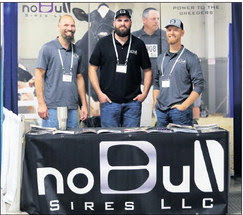 |
From left, Ben Masemore, Ethan Wentworth and Rusty Herr.
Wentworth and Herr are currently in jail afterfacing accusations
of practicing veterinary medicine without a license.
(Photo provided by Ben Masemore)
(Editor's Note: This action taken by Pennsylvania prosecutors should concern goat producers who routinely use ultrasound to determine pregnancy. They can potentially be charged with illegally practicing veterinary medicine. This article is reprinted from the April 20 e-edition of Lancaster Farming (lancasterfarming.com)
By Tom Venesky
Two Pennsylvania men operating a dairy reproduction service are in prison following a complaint of practicing veterinary medicine without a license. Rusty Herr, 43, was booked at the Lancaster County Prison on April 11, while Ethan Wentworth, 33, was sent to the York
County Prison on April 10. Herr and Wentworth are listed as operating partners of Airville-based NoBull Solutions LLC.
Veterinarians have made multiple complaints about “the illegal practice of veterinary medicine by unlicensed individuals employed by NoBull Solutions,” according to a complaint filed with the Department of State in 2020 by thePennsylvania Veterinary Medicine Association.
The complaint alleges that people employed by NoBull were doing ultrasounds and making diagnoses. The document cites reports from veterinary association members and posts on Facebook.
In 2010, Herr was ordered to pay a $3,500 fine and to cease and desist from the unlicensed practice of veterinary medicine. Wentworth got a cease-and-desist order in 2018 along with a $3,000 civil penalty. The 2020 complaint alleges that Herr and Wentworth continued to practice veterinary medicine without a license and hired others to do the same. According to dairy farmer Ben Masemore, who is acting as a spokesman for Herr and Wentworth, both men were advised by their former attorneys not to pay the fines or appear in court because they don’t see an issue with using ultrasound for reproductive services such as pregnancy checks. He said they are both serving 30-day sentences without bail.
Masemore, who is involved with Herr and Wentworth in an unrelated business, said the law governing veterinary practice is vague and doesn’t cover ultrasounding, which is a common practice on dairy farms today.
“I know of up to 20 individuals in the state using ultrasound for reproduction. Anyone can purchase one, as they are readily available today,” he said. Numerous dairy farmers in Lancaster, Lebanon, York and surrounding counties depended on the services offered by NoBull, and the operators’ detention has caused problems for those farms, Masemore said.
The Pennsylvania Veterinary Medicine Association deferred comment to the Department of State, which said it couldn’t confirm or deny an investigation due to confidentiality statutes. A search of Pennsylvania Licensing System Verification didn’t turn up any veterinary license records for Herr and Wentworth.
“The department reviews every potential practice act violation of which it becomes aware, whether that is through a complaint filed directly to the department, a notification from local law enforcement, or through media reports,” State Department spokeswoman Amy Gulli said in an email.
If the State Board of Veterinary Medicine is going to interpret ultrasounding as practicing medicine, the law needs to be changed, Masemore said.
“This really affects every single one of us (dairy farmers). With the economic situation of Pennsylvania dairy, we need all the help we can get,” Masemore said. “It’s not easy out there, and people need to change the way that dairy in Pennsylvania is being treated. We’re being tarred and feathered economically,and the burden keeps getting worse.” A recording on the phone line listed for NoBull Solutions said that due to the legal situation and staff shortages, the business is not scheduling herd checks or horse services before May 20.
The message urges callers to contact the state veterinary board and local lawmakers to express their concerns about the situation. A “NoBull Solutions LLC Defense Fund” has been set up for the men on GiveSendGo and at local banks. For more information, call 717-887-6465.
 |
Goat producers, industry stakeholders join Commissioner at proclamation signing.
Kentucky goat producers and industry stakeholders joined Commissioner of Agriculture Jonathan Shell April 12 as he signed a proclamation declaring April as Goat Month in Kentucky.
“The diversity of goats on our agricultural landscape is one that needs to be celebrated, particularly this month,” Commissioner Shell said. “Not only do they add a uniqueness to farm life, but they are also an excellent source of protein and dairy products. This month we salute all that goats add to our state’s agricultural outlook.”
In the United States, goats are primarily used for producing dairy products, such as milk, yogurt, and cheese, and meat called chevon. Kentucky has 5,300 dairy goats producing quality breeding stock, and healthy, all natural skin products like soaps and lotions. The popularity of goat meat is increasing each year as consumers recognize its benefits. Goat meat is lean with low levels of saturated fat and cholesterol, high levels of iron, and packed with proteins and vitamins. Kentucky ranks sixth in the nation for meat goat inventory with 59,000 head. The meat goat inventory has increased 5.4 percent since 2023, being produced by 4,000 farmers.
In addition to their nutritious value, goats can increase property values. Across the world, farmers use them to combat noxious weeds on their property, promote healthy forests, and prevent wildfires.
“Kentucky continues to be a leader in goat production because of our abundant forages and best management practices. Over 4,000 goat producers work very hard to produce high quality products for consumers,” said Kelley Yates, executive director of the Kentucky Sheep and Goat Development Office. “We are excited to showcase the versatility of goats in Kentucky during the month of April and hope more people learn of their benefits and impact in our state.”
The Kentucky goat industry adds more than $3.5 million in revenue to Kentucky’s agriculture receipts. Warren County is the top county in goat production with nearly 2,800 head, followed by Crittenden, Barren, Clinton, and Nelson counties rounding out the top five.
A variety of goat products can be found at local farmers’ markets or consumers can purchase directly from a producer. The Kentucky Sheep and Goat Development Office offers information on its website with tips for cooking this lean, delicious meat. The website also offers a buyer's guide at: https://www.kysheepandgoat.org/on-your-plate.
|
By Mary Hightower
U of Arkansas System Division of Agriculture
March 6, 2024
Fast facts:
LITTLE ROCK — The March 21 Novel Endophyte Tall Fescue Renovation Workshop at Batesville will help ranchers find ways to manage one of the costliest health problems in the industry: fescue toxicosis in cattle.
One study estimated the annual cost of fescue toxicosis in cattle at $2 billion. Cattle with toxicosis can experience a range of symptoms including lack of appetite, reduced weight gain and in some cases hoof problems or even losing ear or tail parts.

How does this happen?
Tall fescue is a popular forage because of its hardiness and versatility. Part of its toughness comes from its relationship with a certain fungus, known as an endophyte – endophyte meaning “inside or internal fungus.” The endophyte produces compounds that help provide resistance to some pests and give the plant its ability to handle environmental stress.
However, one compound, ergovaline, acts as a constrictor of blood vessels in cattle. The reduced blood flow can leave cattle unable to cool themselves and may also cut blood to extremities like ears and tails.
The good news is all of this is manageable.
"Toxic tall fescue can really impact the production of livestock by interfering with reproduction efficiency and weight gains,” said Maggie Justice, extension beef cattle specialist for the University of Arkansas System Division of Agriculture. “This one-day workshop will focus on some of the key aspects of fescue toxicosis management along with the integration of different novel tall fescue varieties into our grazing systems.
“Our lineup speakers include local Arkansas producers, different seed company representatives along with several extension specialists and researchers from across the country,” she said.
Encouraging producers to move toward fescue with non-toxic — or “novel” — endophytes is a goal of the Alliance for Grassland Renewal, one of the partners for this workshop.
"The Alliance for Grassland Renewal is a collaborative multi-state effort to enhance the understanding of fescue toxicosis management and increase the adoption of novel endophyte tall fescue," Justice said. "The alliance includes researchers from several academic institutions, allied companies and government agencies. We are very excited to welcome these specialists to the state of Arkansas."
The event opens with registration at 8:15 a.m. and adjourns at 4:30 p.m. Participants must register in advance and may register online. Those without the internet can register by calling Maggie Justice at 501- 671-2350. Cost to attend is $40, which includes lunch and materials.
AGENDA
The event is presented by the University of Arkansas System Division of Agriculture, the Alliance for Grassland Renewal and Farm Credit.

The study, which was recently published in the Journal of Occupational and Environmental Medicine, surveyed 987 farmers across the U.S. about their perceived levels of stress and coping behaviors, including alcohol use.
Farmers experience higher levels of work-related stress compared to other industries and the public, and recent studies have found that many turn to alcohol to handle that stress. But not all farmers used alcohol in the same way.
“Female farmers were less likely to report drinking, but then we had these points in the data that we weren’t expecting where there was something going on with binge drinking within our female farmers,” said lead author Christina Proctor, a clinical assistant professor at UGA’s College of Public Health.

For example, said Proctor, women in male-dominated industries like firefighting and commercial fishing reported being held to a higher performance standard and having their authority routinely questioned. And outside of work, these women still bore the brunt of responsibility of housework and as caregivers.
“We thought maybe this is what's going on with our data,” said Proctor. “Maybe there's questioning authority. Somebody comes into your farm, and they ask where the boss man is. You own the farm, but people don't see you as that owner.”
So, they broke down reported stress and drinking behaviors in relationship to gender and the level of responsibility the farmers held.
Compared to their male counterparts, they found that female farmers reported significantly higher levels of stress. And, while female participants were less likely to drink overall, when they did drink, they were more likely to binge drink. This pattern was most pronounced among female farmers who owned or managed farms.
“I think there are moments where the stress associated with farm work and these extra duties are just too hard to handle, where you have to cope with it in some way, and there's just this explosiveness when they do drink,” said Proctor.
This study is part of a larger effort Proctor is leading to understand farmer stress and deliver interventions that help farmers deal with stress in healthy ways. Understanding the range of coping mechanisms farmers are using, and how those may look different across genders and farm roles, is critical to forming tailored mental health and well-being programs.
Proctor is currently interviewing female farmers to better understand the factors that trigger binge drinking.
Two-thirds of female farmers surveyed were farm owners or farm managers, and more women are entering the industry every year.
“We have to figure out a way to support our female farmers, because they are a part of the future,” said Proctor.
Co-authors include Noah Hopkins and Chase Reece with UGA’s College of Public Health.
The paper, “The Intersection of Gender and Occupational Roles in Agriculture: Stress, Resilience, and Alcohol Behaviors of US Farmers,” is available online.

